
Your first flip
starts here.
Place a meme. Win the touching edge.
Turn their card into yours.
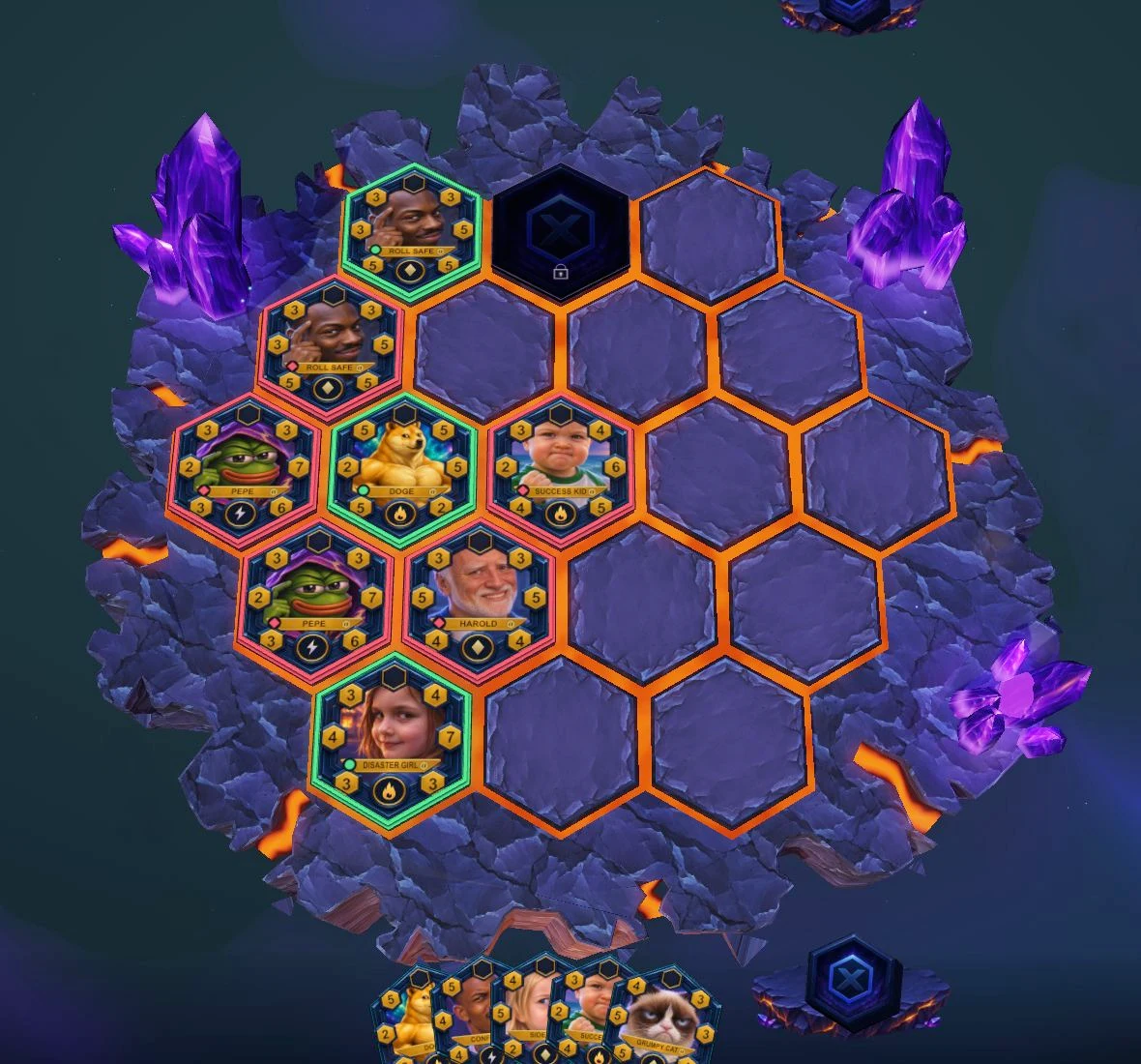
Bring your deck.
15 different memes. Each motif once, across all finishes. Start with five cards in hand.
Read the edges.
Six values, six directions. Only the edges touching an adjacent enemy are compared.
Win the duel.
Own more cards when a round ends. The first player to win two rounds takes the duel.
See the move. Get the game.
Choose a situation, then play the card.
These examples use the game’s capture rules.
4 beats 3. Even against Water.
Compare only the two touching edges. A higher number wins before elements are considered.
Five elements.
One per meme.
Each card has one fixed element, shown at the bottom.
It stays the same in every rarity. Elements only decide ties.
Wins equal-value attacks against
Loses equal-value defence against
No extra point. A higher number still wins. Equal numbers need the attacker’s advantage.
Game terms
- Blockade
- The face-down card marks a blocked hex. Each round draws a different starting hex from across the whole board. Before playing a card, you can move the blockade to a free neighbouring hex once per round. It does not use up your card play.
- Shield · Schild
- A shield raises defence on a specific edge or prevents a capture if its conditions are met. Check the card’s ability for the amount and duration. Water’s Wave Shield gives one edge +2 through the opponent’s next move.
- Phase
- A stage of the older event-field system. Random event fields and their changing bonuses are currently disabled in Random, Private Duels and Deck Test. There is no Phase action to activate.
More terms
- Edge and base value · Kante und Grundwert
- An edge is one of the six numbered sides. The base value is the number printed on it. The value used in a capture can change through ability bonuses or penalties.
- Element
- The bottom symbol shows the card’s permanent element. It decides an attack when the two compared values tie and the attacking element has the advantage.
- Ability · Fähigkeit
- The top symbol identifies the card’s ability. In a duel, select a card and a target hex to see any available choices. Automatic effects resolve when their conditions are met.
- Flip and direct flip
- A flip changes a card’s owner. A direct flip comes from the card you played attacking a touching enemy edge. Some abilities can add a follow-up flip. A double or triple flip means two or three captures with one play.
- Adjacent, ally and Regular
- Adjacent cards share an edge. An ally is a card you currently control. A Regular is a card in the standard class, including its Silver, Gold, Diamond and Void finishes.
- S edge · S-Kante
- An S edge beats any numbered edge. To capture an S, you need an attacking S with the stronger element.
- Final Guard · Schlussschutz
- On the last play of a round, the starting player is protected from the first successful direct capture against them made with a numbered edge. An S attack can still capture.
- Reserve a hex · Feld reservieren
- A reserved empty hex cannot be used for a card placement by the affected player for the stated turn. Disappointed Fan can reserve one for your opponent’s next turn.
- Mute an ability · Fähigkeit stummschalten
- The target temporarily loses its own ability. Its printed edges, element and protection supplied by other cards still apply.
- Draw · Nachziehen
- After playing a card, you draw the top card if your deck still has cards.
Card abilities
The top hex shows the ability. Open an entry to see when it triggers and what it does.
5 abilities
FireEmber Strike · Glutstoß
- When it triggers
- Play a Regular Fire card touching exactly one enemy.
- What happens
- Its edge facing that enemy gains +1 attack for this play.
WaterWave Shield · Wellenschild
- When it triggers
- Select a Regular Water card, target a hex and choose the edge to protect. Confirm the play.
- What happens
- That edge gains +2 defence until your next turn.
EarthBulwark · Bollwerk
- When it triggers
- A Regular Earth card touches an allied card or the blockade.
- What happens
- Its weakest open edge gains +1 defence. The protected edge updates as the board changes.
AirTailwind · Rückenwind
- When it triggers
- Place a Regular Air card, then tap a highlighted allied card if you want to turn it.
- What happens
- The arrow shows the turn. The card turns one step to the right and stays yours.
StormFlanking Lightning · Flankenblitz
- When it triggers
- Play a Regular Storm card touching at least two enemies.
- What happens
- Its weakest numbered edge facing an enemy gains +1 attack for this move.
The abilities listed here are active in Random, Private Duels and Deck Test. Select a card and a target hex during a duel to see any available choices.
Better decisions.
Not rarer stats.
Alpha is complete: 130 different memes — 85 Regular, 25 Iconic and 20 Prime. Each meme has one fixed element and five cosmetic finishes.
Normal, Silver, Gold, Diamond and Void change the art and finish. The same meme keeps the same values and element.
- Exactly 15 cards. Every motif at most once, even across different finishes.
- Up to two Iconics. Iconics have strong numbered sides and deliberate weak spots. No S side. These slots are separate from your Prime.
- At most one Prime. Prime cards have an S side. Only a stronger-element S can capture an S.
- Fixed direction. You cannot rotate a card in your hand. Position is the strategy.
Prime and Iconic cards come from boosters. You can also fill all 15 slots with Regular cards. Rarer finishes never increase power.
Explore the test deck builderSame Doge. Same Fire. Same six values.
The rest, without the rulebook.
How does a round work?
Rock-paper-scissors decides who chooses the first player. There are 19 hexes and one movable blockade, so each player places nine cards. Draw after each placement while cards remain in your deck. The player controlling more cards at the end wins the round.
What happens after a round?
The next round starts automatically after eight seconds. Both decks are reshuffled and the starting player alternates. Draws give neither player a round win. First to two round wins takes the duel. After a private duel, both players can choose Rematch to play each other again. You can save a different deck before accepting. Random duels return to matchmaking after five seconds.
What about the timer and leaving?
Normally you have 90 seconds per turn. After two consecutive missed own turns, your turns allow three seconds until you actively play a card. A timeout makes an automatic legal placement. Confirm Surrender to close the duel and return to the homepage. In Random, surrender counts as a defeat. Private exits award no currencies, XP or quest progress.
What do I earn by playing?
Completed Random rounds against humans or AI grant 5 Pixels for a win and 2 for a loss or draw. A win also grants 100 XP. Private loan decks let you try every released motif without owning it. Borrowing never adds cards to your collection and these decks cannot enter Random. Training and private matches give no rewards. Skill titles and referral qualification require human opponents.
How do collection rewards work?
Collect 50, 75, 120 different motifs to unlock the three portrait-and-title rewards. Finishes do not count as additional motifs. Milestones and already claimed rewards stay recorded, even after dismantling a card.
View collection questsReady to steal your first card?
Start in training, then bring your deck to a duel.